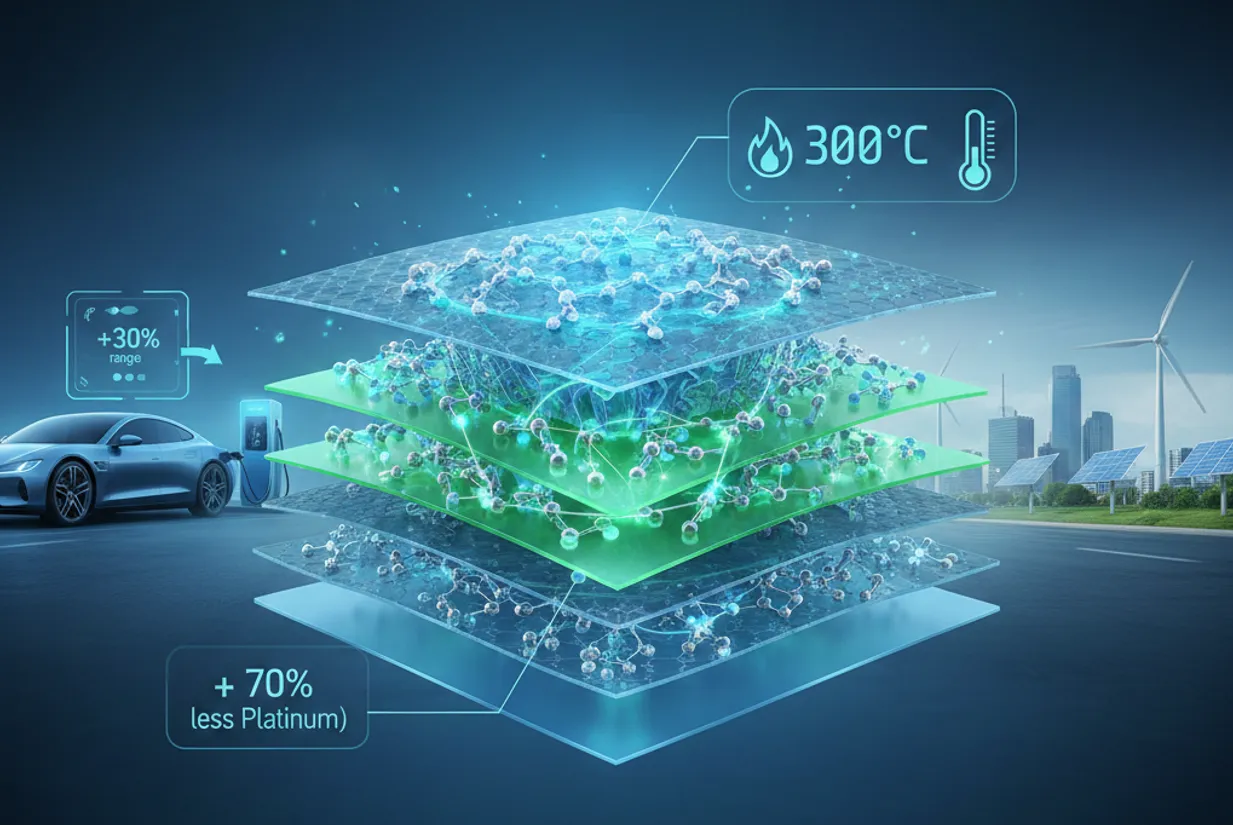
The range of electric vehicles will increase by 30%! Add to favorites
Last update time : 2025-12-07 14:37:04
Kyushu University researchers have unveiled a breakthrough fuel cell material, enabling efficient proton transfer at just 300°C, drastically cutting operating costs and platinum dependency by 70%.
In a major scientific leap for sustainable energy, researchers at Kyushu University have developed a groundbreaking material poised to redefine fuel cell technology. This innovation addresses a long-standing challenge in the sector by achieving highly efficient proton conduction at a significantly lower temperature—just **300°C**.
Traditional high-temperature fuel cells typically demand operational temperatures ranging from 600°C to 800°C, a requirement that complicates system design and limits practical applications. The Kyushu team’s new material effectively eliminates this thermal barrier, making fuel cell systems more viable for everyday use, from portable devices to large-scale automotive applications.
Critically, this low-temperature operation dramatically reduces the reliance on expensive catalysts, such as platinum, by an impressive **70%**. This cost reduction is vital for accelerating the mass market adoption of fuel cells. The technology, which is powered by innovative hybrid nano-structures, promises substantial performance enhancements in electric vehicles, potentially increasing their driving range by up to **30%**.
This breakthrough marks a pivotal moment in the transition to a hydrogen economy and directly supports global carbon-neutrality goals. By making fuel cells more efficient and affordable, the technology stands as a potent tool in the fight against climate change. Prototypes are already undergoing rigorous testing, with the university's research signalling a target for commercialization as early as **2026**.
Tags : fuel cell technology Kyushu University proton conduction low-temperature operation hydrogen economy platinum catalyst reduction sustainable energy carbon neutral electric vehicles
Technology News
Samsung Unleashes Robotics Revolution
How AI Is Consuming the World's Memory Supply
AMD Unveils Ryzen 7 9850X3D
AI Warning: Risk of a Bubble if it's Not Sustainable
SpaceX Bolsters Global Connectivity with Successful Deployment of 29 New Starlink Satellites
Artificial intelligence has landed in the physical world in Las Vegas
AI's Insatiable Data Center Demand Triggers Global Memory Shortage: Prices Set to Surge Through 2026
Navigating the Era of Imperative AI
CES 2026: AI Integration to Take Center Stage in Las Vegas
President Trump Establishes Federal AI Framework, Overriding State Regulations
xAI Unleashes 'Grok Voice 2.0': Next-Gen AI Audio Shatters Latency and Realism Records
Aalto Researchers Unveil Light-Based AI: Ultra-Fast Tensor Computing with a Single Beam
AI Tools
- Aggregators
- AI Detection
- Automation & Agents
- Avatar Creators
- Chatbots
- Copywriting
- Finance
- For fun
- Games
- Generative Art
- Generative Code
- Generative Video
- Image Improvement
- Inspiration
- Marketing
- Motion Capture
- Music
- Personal Development
- Podcast
- Productivity
- Prompt Guides
- Research
- Social Media
- Speech to Text
- Text to Speech
- Text to Video
- Translation
- Video Editing
- Visual Scanning & Analysis
- Voice Modulation